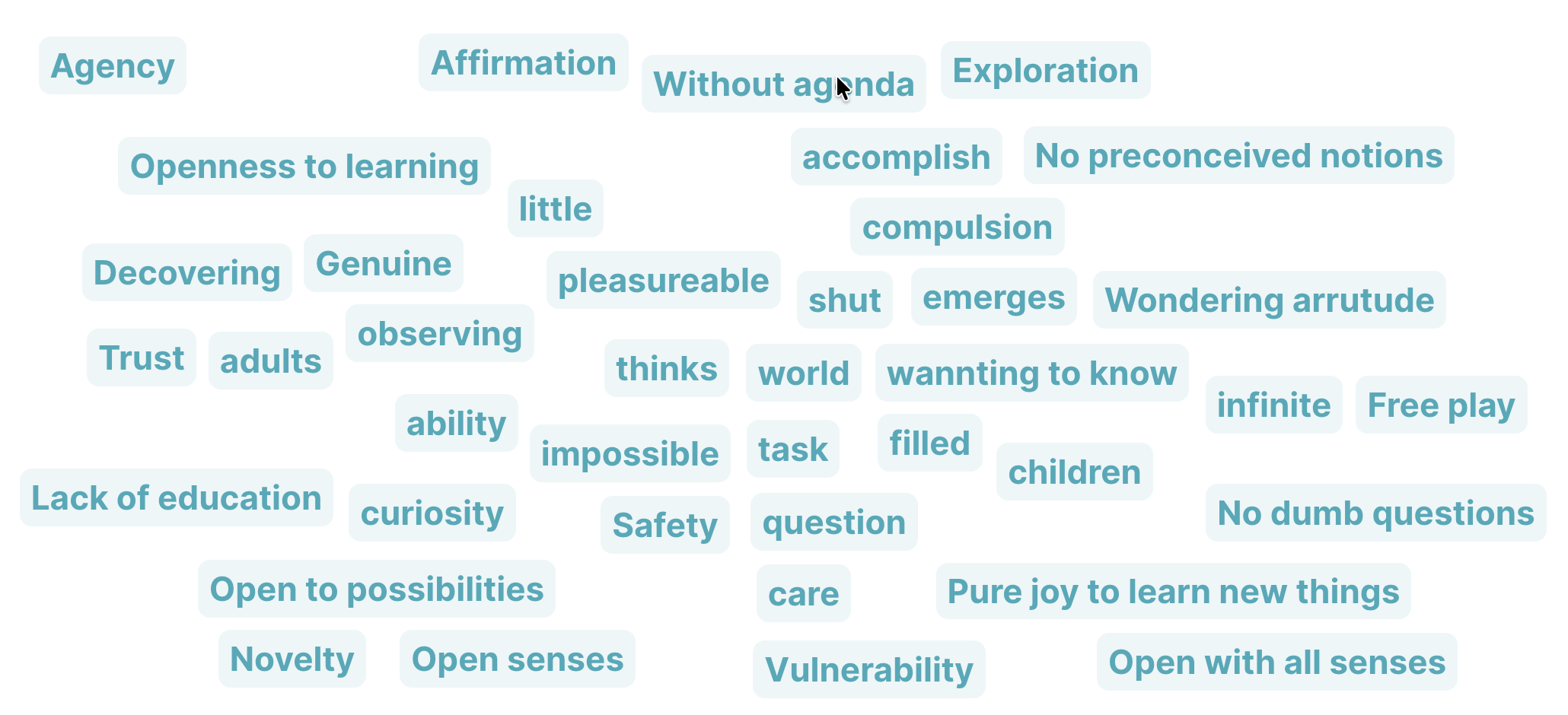
Audience responses to the question: What is Naïve Curiosity?
Presentation: July 22 2026 - ISME IVMTC Preconference: Québec City, Canada
References
Neuralink’s brain chip: How it works and what it means. (2024, February 9). Capitol Technology University. https://www.captechu.edu/blog/neuralinks-brain-chip-how-it-works-and-what-it-means
Bandre, P., Daronde, S., Gourshettiwar, P., Gabhane, D. D., Dhale, T., and Barade, S. (2025). Neuralink: Transforming brain–computer interfaces for medical applications and human-AI collaboration. 3rd DMIHER International Conference on Artificial Intelligence in Healthcare, Education and Industry (IDICAIHEI), Wardha, India, pp. 1-6, https://doi.org/10.1109/IDICAIHEI65991.2025.11378913.
Biggs, J., & Tang, C. (2011). Teaching for Quality Learning at University. Open University Press.
Collinger, J., Wodlinger, B., Downey, J., Wang, W., Tyler-Kabara, E. C., Weber, D. J., et al. (2012). High-performance neuroprosthetic control by an individual with tetraplegia. The Lancet, 381(9866), 557-564. https://doi.org/10.1016/S0140-6736(12)61816-9
Corral, D., & Carpenter, S. K. (2025). Effects of retrieval practice on retention and application of complex educational concepts. Learning and Instruction, 100, article 102219. https://doi.org/10.1016/j.learninstruc.2025.102219
Deci, E. L., & Ryan, R. M. (1985). Intrinsic motivation and self-determination in human behavior. Plenum. https://doi.org/10.1007/978-1-4899-2271-7
Donnellan, E., Aslan, S., Fastrich, G. M., Murayama, K. (2021). How are curiosity and interest different? Naïve Bayes classification of people’s beliefs. Educational Psychology Review, 34, 73-105. https://doi.org/10.1007/s10648-021-09622-9
Dweck, C. S. (2006). Mindset: The new psychology of success. Random House
Gallagher, J. (2012, December 17). Paralysed woman’s thoughts control robotic arm. BBC News. https://www.bbc.com/news/health-20731973
Murayama, K., FitzGibbon, L., & Sakaki, M. (2019). Process account of curiosity and interest: A reward-learning perspective, Educational Psychology Review, 31(4), 875-895. https://doi.org/10.1007/s10648-019-09499-9
Saldanha, P., Vaupel, M. E., Dunn, B. A., & Whitlock, J. R. (2026). Promises and performance in brain-machine interfaces: Will AI be our saviour? The European Physics Journal https://doi.org/10.1140/epjs/s11734-026-02169-2
Sparrow, B., Liu, J., & Wegner, D. M. (2011). Google effects on memory: Cognitive consequences of having information at our fingertips. Science, 333(6043), 776–778. https://doi.org/10.1126/science.1207741
Zimmerman, B. J. (1989). A social cognitive view of self-regulated academic learning. Journal of Educational Psychology, 81(3), 81329–81339. https://doi.org/10.1037/0022-0663.81.3.329
Zimmerman, B. J. (2000). Attaining self-regulation: a social cognitive perspective. In M. Boekaerts, P. R. Pintrich, & M. Zeidner (Eds.), Handbook of Self-Regulation (pp. 13-40). Academic Press. https://doi.org/10.1016/b978-012109890-2/50031-7